
The 19th FIEPS European Congress, held in Antalya, Turkey, in April 2025, brought together approximately 250 participants from 43 different countries leading academics, practitioners, and policymakers to discuss advancements in physical education, physical activity, and sport. The congress emphasized innovative approaches to lifelong engagement in physical and sport education across various settings.
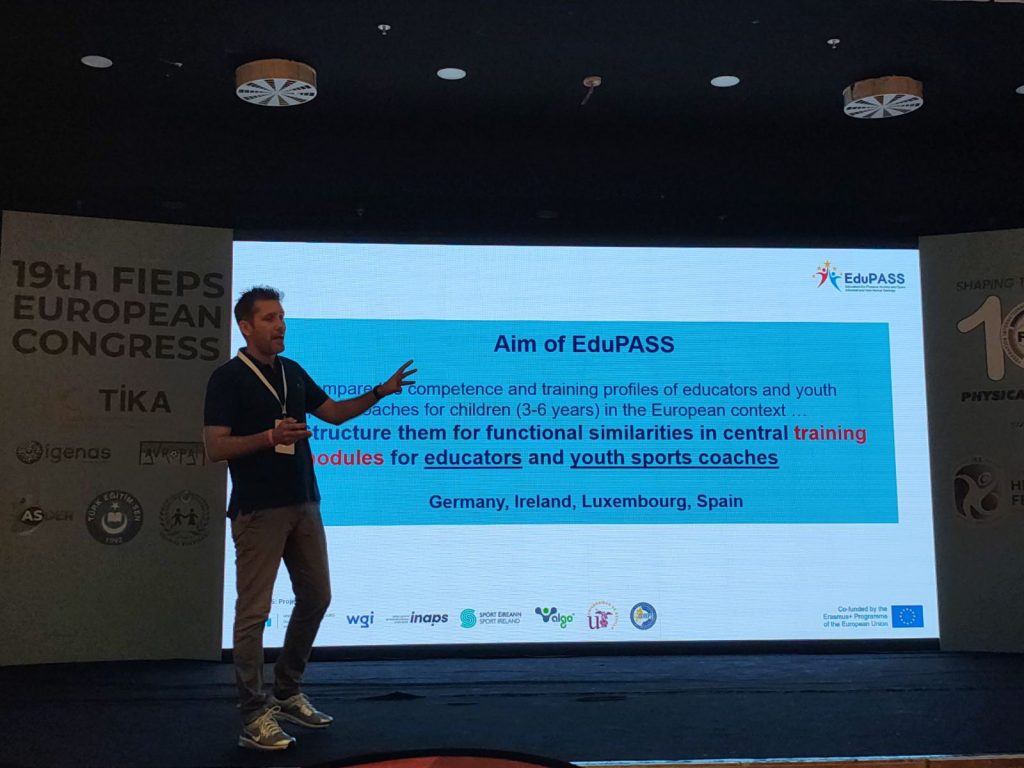
Within this context, the outcomes of the EduPASS project (“Beyond Playgrounds: Equipping Educators and Coaches as Agents of Physical Activity through EduPASS Modular Upskilling”) were presented by the Assistant Professor Dr. Manolis Adamakis. The presentation outlined the development of a comprehensive, competency-based modular training framework grounded in an extensive literature review and a Delphi study. The project produced detailed competency profiles (knowledge, skills, attitudes, and values) and six core training modules, adaptable to diverse national contexts. Emphasis was placed on the innovative online teaching platform and the robust evaluation methodology based on Kirkpatrick’s model.
The contribution was well-received, highlighting EduPASS as a scalable, flexible model capable of improving professional development and promoting physical literacy and holistic wellbeing among children and youth in Europe.
The 19th FIEPS European Congress took place in Antalya, Turkey, in April 2025, gathering international experts, researchers, educators, and policymakers to explore contemporary challenges and innovations in physical education, physical activity promotion, and sport development. The congress focused on enhancing the professional development of physical educators and fostering lifelong engagement in physical activity through evidence-based practices.
In this prestigious setting, I delivered an oral presentation on the Erasmus+ funded EduPASS project, entitled “Beyond Playgrounds: Equipping Educators and Coaches as Agents of Physical Activity through EduPASS Modular Upskilling.” The EduPASS initiative (2022–2024) targets the advancement of professional competencies among Early Childhood Educators and Youth Sport Coaches operating in non-formal (e.g., kindergartens, after-school programs) and informal (e.g., sport clubs) educational environments.
The presentation detailed the systematic development of a modular training framework, built upon a comprehensive literature review and a Delphi study, which informed the establishment of competency-based profiles encompassing knowledge, skills, attitudes, and values. Six core modules, each designed for 30 hours of teaching, were developed for both educators and coaches, with flexibility for adaptation across various European educational and professional contexts.
A central feature of the project is the innovative online teaching platform (https://edupass-project.eu/teaching-platform/), which provides open access to all training modules and fosters interactive, learner-centered methodologies. Additionally, a robust evaluation strategy, grounded in Kirkpatrick’s multi-level model, was introduced to ensure continuous quality improvement and the measurement of participant outcomes.
The EduPASS project was presented as a scalable and transferable model that addresses current gaps in professional preparation for physical activity education, offering significant implications for future practices in higher education, continuous professional development, and youth sport coaching. The contribution was met with interest and appreciation, emphasizing the project’s relevance in promoting lifelong physical literacy and the holistic development of children and young people across Europe.